

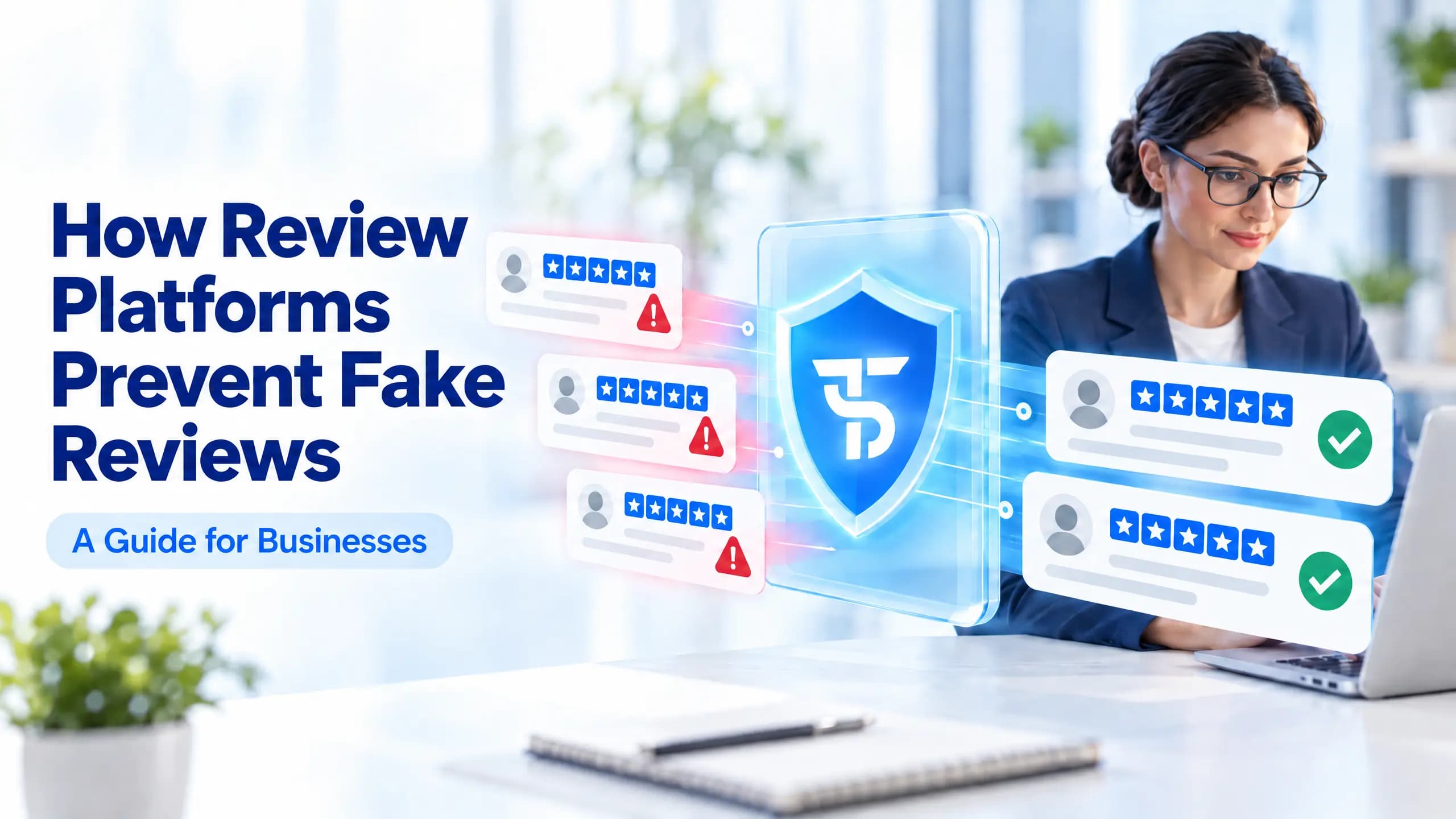
How Review Platforms & Businesses Prevent Fake Reviews - A Guide
Not only do fake reviews mislead buyers, but they also damage a business’s hard-earned reputation on review platforms. In fact, foundational research by Harvard Business School estimates that roughly 16% of unverified reviews on major open platforms are flagged as fraudulent.
At the same time, spotting fake reviews can be tricky, which begs a serious question: how do review platforms prevent fake reviews?
To understand exactly how platforms prevent fake reviews, you have to look behind the curtain at the automated systems working in the background. Most review platforms today use algorithmic filtration to suppress inauthentic feedback. This reliance on algorithmic policing is necessary given that government research, such as a study by the UK Department for Business and Trade, estimates that up to 15% of all product reviews on third-party e-commerce platforms are fake.
That’s why The Trust Search combines transaction proof, automation, and human judgment, where posting a review requires customers to attach their invoice or receipt, which first goes through initial automated checks and then manual audits by a trained professional. Inauthentic reviews are rejected right away, and only authentic ones are published.
However, traditional platforms still rely mostly on automation. Let’s look at how they keep their ecosystems clean and what steps businesses can take to protect their listings.
How the Platforms Filter the Noise

Modern review platforms detect and prevent fake reviews before they’re published. They achieve this by looking at three core pillars of a transaction:
Reviewer History and Behavior
One of the first things review systems check is the account that’s posting the review. This includes checking the account age, such as whether the account is old or was created brand new just minutes ago. Algorithms also check behavior, such as an account that only gives a 1-star rating or an account that always gives a 5-star rating. If a single user is reviewing businesses in five different countries within a single afternoon, the system automatically flags the activity as fraudulent.Text and Image Analysis
Review systems also look for suspicious patterns in text, such as if the review contains repetitive phrasing or language that resembles AI writing very closely. In addition to text, The Trust Search also analyzes invoice images that customers upload, which helps prevent AI-generated or edited invoices.Velocity and Timing
One key aspect of spotting fake reviews is their speed and timing, because fraud usually happens very fast. According to cybersecurity threat reports by Imperva, malicious bots now account for 40% of all internet traffic, meaning platforms must constantly monitor for unnatural, automated spikes in fake account creation. A local coffee shop that gets three reviews every week suddenly receiving 40 reviews in 2 weeks becomes suspicious activity. The system detects and flags the accounts involved in this sudden burst.
The Two Types of Review Ecosystems

Not all review platforms are built the same way. Understanding this distinction helps us understand how different platforms operate. There are two main kinds of review ecosystem:
Open Platforms: These allow anyone with an email address to leave a review. While they capture a large volume of public sentiment, they require heavy, constant algorithmic policing because the barrier to entry is so low.
Verified-Review Platforms: These platforms operate on closed-loop systems in which a customer can only post a review if they prove that they’re a real customer. The Trust Search also operates on this model since we require buyers to back their reviews with authentic invoices.
The major difference is volume vs. authenticity. Open platforms have a low entry barrier; that’s why they’re also more prone to fake reviews, whereas verified-review platforms set the entry barrier very high; they have less traffic, but their reviews are much more trustworthy.
How The Trust Search Prevents Fake Reviews

The Trust Search is a verified-review platform. This means every review on the platform goes through strict verification before it’s uploaded. Because we believe truth shouldn’t only be claimed but also be proven, we maintain a very high standard for entry by requiring transaction proof.
Here’s how The Trust Search works and how we prevent fake reviews:
Here’s how review verification works on The Trust Search:
1. Transaction Proof Is Required
Every reviewer needs to prove that they have experienced the brand they’re reviewing. To achieve this, we require every customer to attach a valid receipt or invoice and get it verified.
2. Initial AI Checks
When a reviewer uploads their invoice, it first goes through initial AI checks. In these checks, our system looks for signs of inauthenticity, including but not limited to:
Whether the invoice’s format matches the business’s actual invoice format or not
Whether the invoice is real, edited, or AI-generated
Whether the invoice’s content appears real or is a placeholder
At the same time, the system also redacts the customer’s personal information, such as phone number and card details.
3. Manual Human Audits
AI does only 10% of the verification. 90% of the work is actually handled by human auditors.
Once the initial AI checks are complete, the reviewer is allowed to submit their review if all verifications are passed. After that, the review is audited by a trained professional who manually examines it. They look for all kinds of suspicious signs that may suggest that the review is fake, including:
the customer’s account history,
the review’s contents,
transaction context,
star rating,
time of posting,
invoice details, and
other aspects.
At this stage, the review is thoroughly verified.
4. Verified Review Gets Published
After all checks are completed, the verified review gets published with a verified badge.
This strict verification system helps us prevent the majority, if not all, of fake reviews, making us an authentic review platform you can trust. However, despite extensive verification, community members and businesses can still flag and dispute reviews they find suspicious or fake. All flags and disputes are also moderated by humans.
This way, we ensure every review your business gets comes from a genuine customer and represents your brand with utmost authenticity. This also means that, as a business, you can focus on improving what you do based on what your customers really think about you.
How Businesses Spot and Prevent Fake Reviews

It’s important for business owners to understand how to spot and prevent fake reviews, especially if they’re present on multiple review platforms.
The most common red flag is a lack of description. Most fake reviews tend to be vague and short. They express the sentiment, but not the experience. Reviews like “Terrible experience," “Very disappointed," or “Best brand ever” are some of the examples. If you also notice a sudden spike in negative reviews that does not align with your actual sales volume or customer support tickets, your brand could likely be under a coordinated attack.
How to Protect Your Brand

You don’t have to sit back and watch if you detect suspicious activity happening on your profile. Here’s how you can detect and prevent fake reviews.
1. Flag or Dispute
Almost all review platforms have a flag or dispute system that allows businesses to report reviews that violate their terms of service. Report the review to the platform and state the reason. Provide evidence if you can, such as transaction logs of customers to prove that the reviewer was never a customer.
2. Focus on Verified Reviews
One of the best ways to keep your rating authentic is by focusing on customers who have actually experienced your services or products. Send review invitations to genuine customers right after their purchase is confirmed.
3. Leave a Professional Reply
You can also respond to a fake review. In many cases, a professional and polite response can help minimize damage and prevent new buyers or profile visitors from believing the review. Respond by acknowledging the reviewer’s problem briefly while keeping a neutral tone while stating that you found no record of the customer’s transaction.
If you’re on The Trust Search, you can learn more about what’s expected of you when responding to customer reviews in our business guidelines.
4. Understand the Legal Protections
Governments are increasingly stepping in to protect both consumers and businesses from deceptive practices. Recent federal guidelines have made it explicitly illegal to buy, sell, or manipulate online reviews. This shift means businesses now have stronger legal backing when escalating severe cases of review fraud or extortion.
Conclusion
Business reputations depend on the authenticity of their reviews, yet fake reviews can be tricky to spot. How review platforms prevent fake reviews is mainly determined by their review ecosystem, but most platforms look for common signs, including account history, text and image authenticity, and the speed and timing of incoming reviews.
Businesses can also take steps to protect their ratings, such as by flagging suspicious reviews to the platform, focusing on verified customers, and understanding legal protections. This way they can maintain a more authentic reputation and avoid falling into legal jeopardy.
Frequently Asked Questions
How to detect fake reviews?
Look for patterns that are most commonly associated with fake reviews, including generic wording, a lack of description, suspiciously specific marketing terms or SEO keywords, a newly created profile, extreme ratings (1-star or 5-star), extreme sentiments (extremely negative or overly positive), and an inorganic account history. Spotting fake reviews can be tricky at first, but it gets easy as you become familiar with common patterns.
How can I remove fake reviews from my reviews?
To remove fake reviews from your reviews, first identify which reviews are fake, then flag or report them to the platform, state your reason for the removal request, and provide evidence to support the claim. If your rating was changed within a short period, report all suspicious reviews posted in that duration.
How to prevent fake reviews?
Preventing fake reviews requires acting proactively. However, no matter how strong your defense, some fake reviews can always slip through. One of the best ways to prevent fake reviews is by building your reputation on a verified-review platform like The Trust Search, where individual reviews are manually vetted to prevent fake ones.
Share this article

